OUR TECHNOLOGY
ENGINEERING THE FUTURE OF AIR CARGO
The 80-Year Stagnation
Freight Has Been Flying in the Wrong Airframe.
Cargo aircraft design hasn’t fundamentally changed for almost a century. Most freighters are retrofitted passenger planes that were designed for human transport, not freight.
A NEW AIRFRAME FOR FREIGHT
Our Blended Wing Body airframe unlocks a fundamentally larger internal volume and higher payload capacity than tube-and-wing designs of comparable size. Beyond the airframe itself, a wide rear cargo door and integrated ramp eliminate the bottlenecks that slow conventional freighter turnarounds, enabling rapid loading of standard pallets, oversized freight, and special cargo without compromise. These are just a fraction of the cargo-first features and technologies being engineered into every element of the aircraft.
INTEGRATION OF HYDROGEN PROPULSION
Liquid hydrogen as fuel for a BWB freighter creates a synergy that redefines what cargo aviation can achieve. Liquid Hydrogen (LH2) contains nearly three times the specific energy of standard jet fuel by mass, but requires roughly four times the physical volume. Traditional tube-and-wing aircraft cannot accommodate this without heavily sacrificing cargo space.
The Volume Solution
Our BWB airframe provides the volumetric space needed for the bulky LH2 cryogenic tanks while keeping the primary cargo bay completely unobstructed.
The Range Extender
The BWB’s superior lift-to-drag ratio, combined with the low mass of LH2, offsets the mass penalty of cryogenic systems to deliver extended operational range without compromising payload capacity.
The Cargo Advantage
The internal architecture unconstrained by passenger requirements allows the interior to be fully dedicated to optimal LH2 tank integration and maximum cargo capacity.
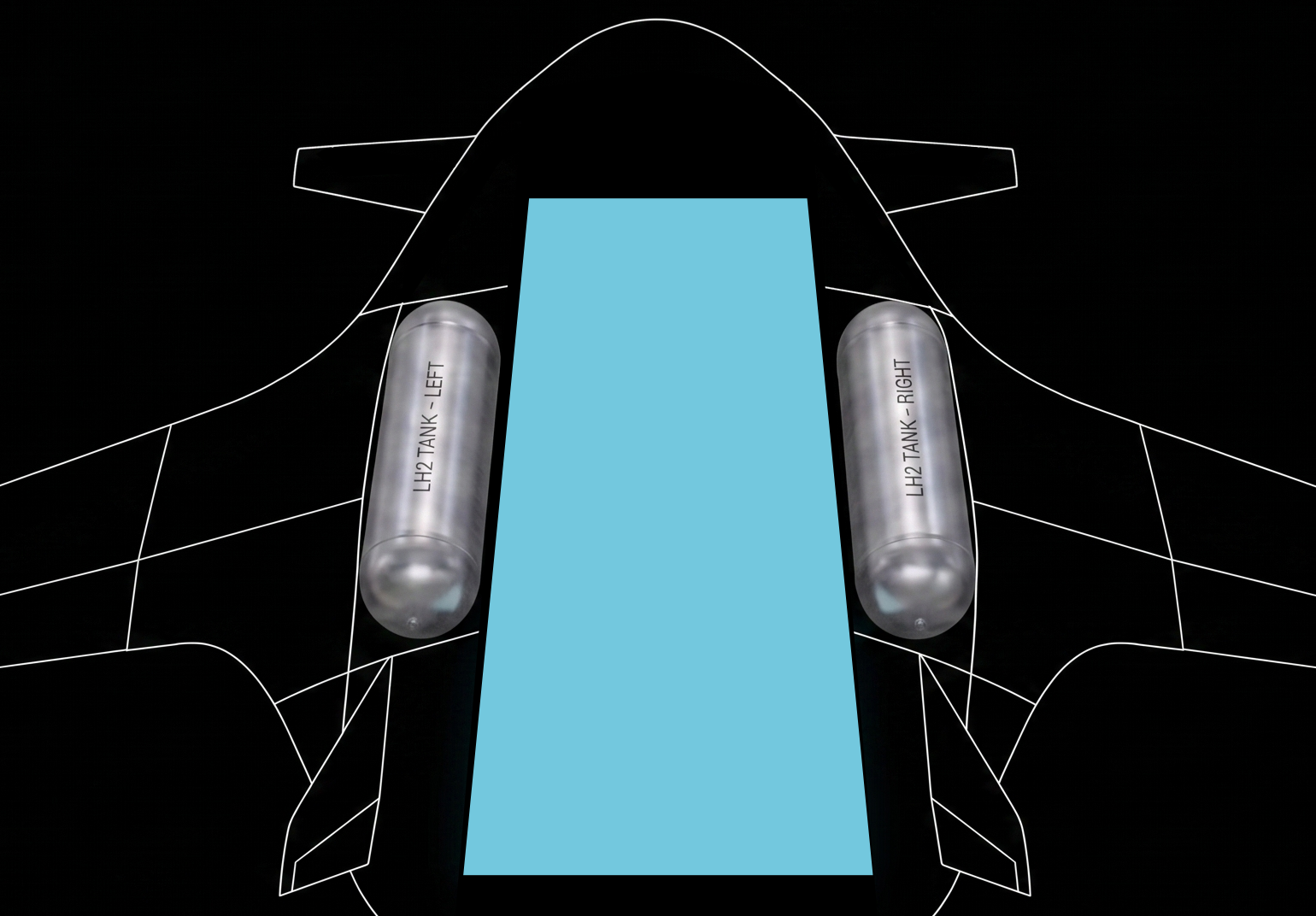
* For illustrative purposes only. Not to scale.
ENERGY DENSITY
Liquid hydrogen contains 3x more energy per kg than Jet Fuel, enabling lighter take-off weights.
ENERGY INDEPENDENCE
Water-to-Fuel ecosystem. Decouple your fleet from global oil fluctuations through onsite electrolysis and liquification.
COST STABILITY
Less affected by global oil market fluctuations. As electrolyzer and liquefier efficiency is improving and hydrogen supply growing each year, levelized cost of hydrogn (LCOH) is projected to decline substantially over the next years and decades.
Integrating the most advanced hydrogen aviation technology available
Hydrogen Electric
(small scale)
Integration of hydrogen-electric systems on small-scale airframes (AH2).
Hydrogen Electric
Integration of advanced hydrogen-electric powertrains for larger, medium-range aircraft (AH10).
Hydrogen Combustion
Direct hydrogen combustion turbines for heavy-lift, intercontinental operations requiring maximum thrust.
TACTICAL ADVANTAGE
H2 BWB AIRCRAFT FOR DEFENSE LOGISTICS
LOW THERMAL SIGNATURE
Hydrogen-electric fuel cell systems operate at significantly lower temperatures than gas turbines, drastically reducing the infrared signature against adversarial targeting systems.
Noise Reduction
Hydrogen-electric propulsion placed above the airframe reduces noise significantly, enabling quiter operations for noise-sensitive missions.
RESILIENT SUPPLY
In contested environments, forward operating bases can synthesize hydrogen fuel directly from water and deployable solar/nuclear sources, eliminating vulnerable fuel convoy lines.
We’re actively seeking strategic partnerships across four core pillars:
Commercial Operators
Engaging with regional cargo airlines and middle-mile cargo networks for pilot programs and advisory partnership.
Propulsion & Hydrogen
Collaborating with innovators in hydrogen storage, fuel cell technology, and electric powertrains.
Suppliers
Seeking Tier-1 suppliers to integrate proven, flight-ready technologies into our BWB platforms.
Defense & Government
Partnering with defense contractors and government agencies to tailor our dual-use platforms for strategic airlift and contested logistics.